
SATURDAY, MARCH 27, 2027
Easter Celebration
7:30 PM | MANSFIELD THEATER, GREAT FALLS
PRE-CONCERT TALK | 6:30 PM | FREE

SEASON SPONSOR

CONCERT SPONSORS
TIM & DARCY WILKINSON

MUSIC DIRECTOR SPONSORS

WHAT'S INTERESTING ABOUT THIS CONCERT
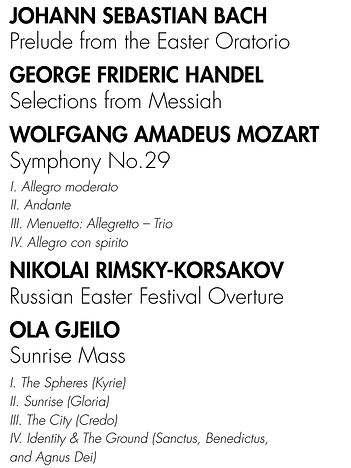
Mozart composed his Symphony No. 29 in 1774 when he was just 18 years old. Despite his age, the piece already shows the imagination, emotional depth, and effortless charm that would later make him one of history’s most celebrated composers.
Handel’s Messiah may be a Christmas-season tradition today, but much of the work actually tells the Easter story. Its second and third parts move through Christ’s Passion and Resurrection to the promise of eternal life, including the iconic “Hallelujah” Chorus.
Ola Gjeilo’s Sunrise Mass takes listeners on a musical journey from darkness to light, beginning with the mysterious vastness of “The Spheres” and ending in quiet peace. Premiered in 2008, it blends centuries-old influences like Gregorian chant with lush, cinematic harmonies—and has become one of the most frequently performed major choral works of the 21st century.
SATURDAY
27
MARCH, 2027
CONCERT START 7:30
PRE-CONCERT TALK 6:30
DURATION
1 hour, 41 minutes
(includes 20-min. intermission)
EVERYONE BELONGS AT THE SYMPHONY
Clap when you feel it.
Pre-concert talk | 6:30 PM | Free
Enjoy your concession drink at your seat.
Phones on silent are welcome.
Concert Details
_edited.jpg)

ABOUT THE MUSIC
PROGRAM NOTES WRITTEN BY ROBERT KAHN
Composed for Easter Sunday in Leipzig in 1725, Bach’s Easter Oratorio celebrates the joy of Christ’s resurrection. Unlike his Passions, which depict the suffering leading to the Crucifixion, the Easter Oratorio begins after the Resurrection, filling the music with celebration and hope.
Its opening Prelude immediately announces that spirit. Brilliant trumpets, jubilant timpani, and energetic strings create an atmosphere of unmistakable festivity, making it one of Bach’s most radiant orchestral openings.
Prelude from the Easter Oratorio
1725
Johann Sebastian Bach
1685 -- 1750
5 MINUTES
Although Messiah is often associated with Christmas, its second and third parts tell the Easter story through Christ’s Passion, Resurrection, and the promise of eternal life.
These selections trace that journey. Since by Man Came Death contrasts humanity’s mortality with the triumph of the Resurrection, while the famous Hallelujah Chorus proclaims Christ’s victory with brilliant choral writing and triumphant brass. The concluding Worthy Is the Lamb… Amen brings the oratorio to a magnificent close, combining Handel’s dramatic power with one of the greatest fugues in the choral repertoire.
Selections from Messiah
1742
George Frideric Handel
1685 -- 1759
10 MINUTES
Composed in 1774 when Mozart was just eighteen years old, the Symphony No. 29 stands among the earliest masterpieces of his orchestral career. Written years before his great Viennese operas and final symphonies, it already reveals the elegance, imagination, and emotional depth that would define his mature style.
Unlike many symphonies of the period, Mozart achieves remarkable expressive range with relatively modest orchestral forces. The graceful opening movement balances youthful energy with lyrical refinement, while the tender slow movement offers moments of quiet intimacy. A lively Minuet leads to a sparkling finale filled with wit, rhythmic vitality, and effortless charm.
Though written by a teenage composer, the symphony displays a confidence and sophistication that continue to captivate audiences. Its warmth, optimism, and radiant spirit provide a perfect complement to the spirit of celebration heard throughout this program of Easter Celebration.
Symphony No. 29
1774
I. Allegro moderato
II. Andante
III. Menuetto: Allegretto – Trio
IV. Allegro con spirito
Wolfgang Amadeus Mozart
1756 -- 1791
27 MINUTES
Composed in 1888, Rimsky-Korsakov’s Russian Easter Festival Overture celebrates Easter through the traditions of the Russian Orthodox Church. Drawing on ancient liturgical chants, the work begins in quiet solemnity before bursting into a dazzling orchestral celebration.
A master orchestrator, Rimsky-Korsakov fills the score with brilliant colors, ringing fanfares, and exuberant dance rhythms, capturing both the spiritual reverence of the Easter Vigil and the joyful festivities that follow. The result is one of the most spectacular concert overtures in the orchestral repertoire.
Russian Easter Festival Overture
1888
Nikolai Rimsky-Korsakov
1844 -- 1908
15 MINUTES
Since its premiere in 2008, Ola Gjeilo’s Sunrise Mass has become one of the most frequently performed large-scale choral works of the twenty-first century. Although it sets the traditional Latin Mass, Gjeilo conceived the work less as a liturgical composition than as a universal meditation on humanity’s journey “from darkness to light.”
Scored for choir and string orchestra, the four movements unfold as a continuous emotional arc. The opening movement “The Spheres” evokes mystery and vastness, while the luminous “Sunrise” gradually fills the musical landscape with warmth and light. The energetic “The City” portrays the vitality of human life before the final movement, “Identity and the Ground”, returns to a place of quiet reflection and peace.
Rather than emphasizing dramatic conflict, Gjeilo’s music invites contemplation. Drawing inspiration from Gregorian chant, Renaissance polyphony, and the soaring harmonies of contemporary film music, Sunrise Mass speaks in a language that feels both timeless and unmistakably modern. Closing today’s Easter Celebration, it leaves us with a message that resonates far beyond any single tradition: hope, renewal, and the promise of new beginnings.
Sunrise Mass
2008
I. The Spheres (Kyrie)
II. Sunrise (Gloria)
III. The City (Credo)
IV. Identity & The Ground (Sanctus, Benedictus, and Agnus Dei)
Ola Gjeilo
1978-